Thursday, October 11, 2012
Tuesday, September 11, 2012
Too Long For Facebook
A Facebook friend of mine posted this link from NPR to my wall and asked "Comments?"
Careful what you wish for. The information in the link is not entirely accurate; what follows, on the other hand, is accurate. Allow me to geek out.
The resurgence of
tailored menswear has brought confusion. Many
off-the-rack retailers advertise clothing with “bespoke details”
and the word “custom” has been confused with “made-to-measure”
to the point where both have nearly been rendered meaningless. To
eliminate the confusion on the matter, here's the difference among the terms "ready-to-wear (RTW)," "made-to-measure (MTM)," and "bespoke."
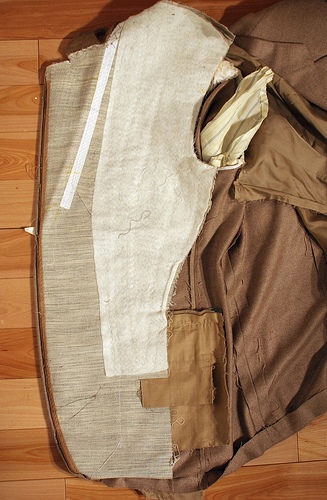
Before we get into these differences, we need to know how canvas works. Nearly every suit jacket has some kind of canvas between the fabric and the lining of the jacket. Higher-end jackets, regardless of whether they're RTW, MTM, or bespoke, will have natural canvas (usually a woven horsehair/linen blend) that's tacked to the fabric and acts as a free-floating third layer. It breaks in over time, lasts longer, and molds to your body shape. Cheaper jackets (most RTW and some MTM's) use a fused canvas, which is a synthetic reproduction of natural canvas that is glued (fused) to the fabric. It's faster and less expensive, thus keeping costs down. To say that the lining and fabric are fused together as the graphic does is inaccurate. It's also worth noting that full-canvased RTW suits with expensive materials exist, which the graphic linked to above ignores.
We also need to know what a "pattern" is. When a suit is made, something called a “pattern” is drawn. This isn't a pattern like pinstripes or checks, but rather the shape of each individual panel of the suit. This is drawn with pencil onto paper and cut out into the aforementioned panels. These paper panels are then placed onto the fabric that will be used for the suit and their outlines traced with tailor's chalk, at which point they are cut and sewn together into a wearable garment called a suit.
In short, any suit (RTW, MTM, or full custom) can theoretically be constructed using whatever method the manufacturer or customer chooses.
RTW suits are all made from block patterns (tailorspeak for a stock size), assembled en masse in a factory, shipped to stores and sold as finished garments. These are generally cheaper because of their mass-produced nature and generally employ a fused construction but may also be half-canvassed (described correctly in the graphic) or fully canvassed.
If a suit is classified as
MTM, that means
that a client's measurements have been taken and his suit will be cut
from a pre-existing block pattern that
is altered to fit those measurements. The operative term here is
pre-existing, which is to
emphasize that in a made-to-measure scenario, a pattern is not
drawn from scratch for an individual customer. There is generally
more machine work involved in made-to-measure garments and a limited
amount of hand work; as a result they tend to be less expensive than
their bespoke counterparts and therefore serve as a good introductory
customized garment for a lot of men. These too may be fused, but are generally half- or fully canvassed.
“Bespoke”
or “custom” garments, on the other hand, are a different story.
In this situation, the client's measurements are taken and then a
pattern is drawn for him from scratch. These garments traditionally involve no less than three fittings and involve 60+ hours of work. This is the more traditional way of constructing a custom suit, as
made-to-measure is a more modern, technologically driven construction
method. Custom garments tend to be made mostly by hand, which
increases the turnaround time, quality, and expense. If you ever see
a garment advertised as “custom” or “bespoke” and it costs
less than $2000 at full retail price, chances are a
less-than-scrupulous retailer isn't being totally honest with you. I have never heard of a wool bespoke suit being anything but full canvas.
My tailor summed it up very nicely when he said, “Made-to-measure is like
customizing a track house that is being built in a new development
with the guidance of a real estate agent or the land developer.
Bespoke is having a custom house built on your own land with the help
of an architect and contractor.”
Price is always influenced by two factors: construction and fabric. You can put an expensive fabric on a cheaply made RTW suit or put a cheap fabric on a full-canvas custom suit and spend $2000 either way, more than the graphic indicates. To say price is determined solely by a suit's status as RTW, MTM, or custom is an oversimplification.
NPR doesn't get into this, but it's important to understand that while different construction/fabric combinations command different prices, the more relevant aspect for a suit-wearer is value, which varies from person to person. Do you work in construction and wear a suit 3 times a year? You're better off going with a fused suit, as that rate of wear will allow it to last you an incredibly long time. Do you wear a suit five days a week to your white-collar job? If so, think about it in terms of cost-per-wear. Better-constructed suits will last longer with heavier wear, meaning that the while the up-front investment is higher, it will actually save you money in the long run.
As always, different strokes for different folks.
Thursday, August 30, 2012
Hidden Treasure
I know this is a crap photo, but since I've been talking about ties and pocket squares, I figured this little combo was relevant. The colors sync up nicely here; there's orange in both pieces, but the hanky has hints of purple and blue in the plaid, though it's tough to see in this picture. Orange and purple is one of my favorite color combinations, and I can't believe it's taken me this long to mix these two items, given that I've had both in my closet for at least two years. It was like finding hidden treasure.
Next up: ruffly pirate shirts.
Wednesday, August 29, 2012
The Tie/Handkerchief Dilemma
We're
living in well-dressed times. More than any time in the past decade,
men have lately been taking more pride in their appearance and the
image it projects. While it's important to have some natural ability
in matters of attire, it's equally (if not more) important to learn
the rules of clothing to as to manipulate them and, eventually,
tastefully break them. The first concept where men can generally use
some guidance is coordinating a tie and pocket square.
First
and foremost, note usage of the word “coordinate” as opposed to
“match.” To match your tie to your handkerchief is poor form for
a couple of reasons. For starters, it draws the viewer's eye
horizontally across your chest and takes attention away from your
face, which does you no favors at all.
Secondly,
it lacks sophistication. Certain things make sense to be sold in
pairs: shoes, socks, cufflinks, the Olsen twins on the black market. Ties and pocket squares, on
the other hand, should be sold separately. Anyone selling them in
matching sets is a clothier of dubious distinction and is not to be
trusted, much less supported with your business.
Successful
coordination between ties and hankies isn't all that difficult if you
think of both in terms of color and pattern. For example, let's say
you're wearing a red/blue striped tie like I am in the picture above. If you'd like to coordinate
the stripes, wear a handkerchief with blue/white stripes or a plaid,
as the straight lines of the plaid sync up nicely with those of the
striped tie. If you'd like to focus on color, you can do solid red,
solid blue, blue with red dots, red with blue paisley, etc. As you
get a bit more advanced, you can start playing with complementary
colors: that same red/blue tie can take a purple pocket square, for
example, because blue and red make purple. For more insight on this,
all you have to do is remember your primary (red, blue, and yellow)
and secondary colors (orange, purple, and green). Most of these
colors will play nicely with the others, depending on shade.
As
a guideline, remember that a white pocket square goes with anything
and is to be worn exclusively with semi-formal and formal wear.
Finally, keep in mind the Rule of Two, oft-stated as “one for
blowin', one for showin'.” The idea here is that a gentleman has
two handkerchiefs at all times: one for show in his breast pocket,
and one in his back pocket should he or someone else need it to clean
up a spill, wipe away sweat, and even plug up a nosebleed.
Perfect for the pugnacious gentleman, eh?
Sunday, August 12, 2012
Style Profile: Paul F. Tompkins
Last Friday night I had the pleasure of going on a double date with my girlfriend and a couple of friends of hers to see Paul F. Tompkins at Plays and Players Theater in Center City. A brief review:
1. The man does high-brow humor incredibly well. Not only did I laugh my ass off throughout most of his show, his usage of the word perfunctory forced me to look it up on dictionary.com (decidedly not in a perfunctory way), so I learned something too. Bonus!
2. Mr. Tompkins can dress. Like, really well. Take a look:
I lifted this picture from his Facebook page; hopefully my admitting this and the fact that I make no money whatsoever from this (obscure) blog (with a whopping 46 followers) will contribute to his not filing a lawsuit against me for using his likeness.
Anyway, he's pictured above in the same jacket and bow tie he wore when I saw him, and I'm 90% sure the pants are the same. This look is excellent because not only is it completely dandy -confident, colorful, and perfectly tailored- but it's also a great image projection for both his personality and his profession as an entertainer. He's clearly having fun with how he dresses, but the cut and proportion of his clothing are so exact that it screams, "I am smart professional who's good at what he does." His hair and mustache, while unfortunately reminiscent of Will Ferrell's Ron Burgundy, hearken back to burlesque days when taken in context with his outfit. Here's a breakdown of what's going on here:
1. The Jacket: This is clearly the center piece of the outfit. It's a great shade of medium blue with a bold chalk stripe and is a relatively unconventional 4x2 double-breasted model (meaning it has four outside buttons, two of which are functional). I can't know for sure, but I'll bet that it's custom, judging from the color of the buttons and the contrast-colored stitching on the front-most sleeve button. It was properly done with peaked lapels and side vents, and trust me when I say that the fit was, to quote Marisa Tomei's character from My Cousin Vinny, "dead-on-balls accurate."
2. The Bow Tie: Perfectly proportioned insofar as it wasn't wider than his face, and the color coordinated beautifully with the jacket. Also, he was wearing a friggin' bow tie! How awesome is that?
3. The Shirt: I remember him wearing a white barrel-cuff shirt at the show, but he's pictured here in a French cuff number. You can tell it's custom from the monogram on the left cuff, and while I can appreciate a monogram, I have to say that putting them on a visible part of your clothing strikes me as pompous. I don't think Mr. Tompkins is a pompous individual, so since he's obviously reading this (right?), I humbly suggest taking a cue from Fred Astaire in the future and placing his monogram on the left front of his shirt where it'll be covered by his jacket. It also has a certain old-school charm that I'm a fan of.
4. The Pants: Whereas the jacket is bold and attention-grabbing, the pants Mr. Tompkins opts for here are the perfect counterpoint in their simple grey solidity. Matching the trousers here could work, but it could also turn into costume-y overkill very easily. He made a great choice to tone it down here.
5. The Mini-Boutonniere: I love this for two reasons: men don't wear boutonnieres often enough, and it makes up for his lack of handkerchief. Well-played.
Though they're not visible in the picture, he was wearing brown dress loafers and red socks (matches the boutonniere!) at the show. This guy was killing it sartorially AND comedically; to that end, I leave you with this:
Friday, August 10, 2012
Tough Guys Wear Pink, Pt. II
Though the heat and humidity at this point in the summer make me yearn for fall, I never want to give up wearing bright colors with the change of season. I always think color is just more interesting to look at as opposed to wearing just neutrals like black, grey, or cream, but I mostly enjoy the challenge of pairing colors that complement each other well. I was so pleased with the combination you see below that I took thirty seconds out of my day to post it on Facebook, so you know it's a huge deal:
The shirt is a custom one from my new job and the tie is at least seven years old, bought at Banana Republic when I worked there. Pink and blue is a can't-miss combo, especially if your facial complexion has a pinkish hue to it. Many pasty white men like myself have this complexion. If you have blue eyes, all the better. The lesson here is that when you mimic the background colors in your skin or your hair and eye color, you do yourself a huge favor in terms of elevating your countenance from "nice" to "awesome." I didn't make this discovery myself; many a menswear author like Alan Flusser have written about the subject already, so know that I'm regurgitating information here. But keep in mind that it's very useful information.
Please don't hesitate to ape this combo; it's not like I was the first guy to ever do it, and I certainly won't be the last. If you do, pairing it with dark jeans, grey slacks, or navy blue pants is a home run.
Style vs. Fashion
I'd like to start this entry off with a brief quiz:
Please select how you prefer to hear yourself described:
a. As a stylish guy.
b. As a fashionable guy.
Ah, the age-old question of fashion versus style. The difference is akin to that between a square and a rectangle. While every square is a rectangle but not every rectangle is a square, all stylish men are fashionable but not all fashionable men are stylish.
Fashionability is wearing whatever the people at GQ decide is cool for any given season. For the past few years, this has meant super slim skinny jeans, tiny suits with narrow lapels, one-inch-wide ties, breakless pants that sit low on the waist, or whatever else the Sartorialist seems to enjoy photographing. A lot of what we're going to see for Fall 2012 in men's suiting is the double-breasted suit, but with the bottom two buttons missing. Like many fashion trends, it's an interesting idea on paper but is silly upon execution.
To be fashionable is to be strictly of the moment. To be strictly of the moment is to not be timeless.
Stylish men, on the other hand, understand that looking good is not so much about wearing the latest trends but rather about understanding your body type and complexion and how those relate to the silhouettes and colors that work for you specifically. It's also about the geometrical relationship amongst the garments themselves. They may flex some trendier items into their wardrobes, but only if those items work within the aforementioned parameters. Armed with confidence because they're playing to their strengths and minimizing their weaknesses, they acquire true style not just in their clothing, but in all aspects of their lives, right down to the way they stand. Well-fitting clothes will make you stand up straighter, I swear.
Stylish men are comfortable in their own skin and their clothes are a an extension of that skin.
Subscribe to:
Posts (Atom)